Nonogram 20x20
A 400-square puzzle for a longer session; progress is saved in your browser.
Recent
Your last 10 settings, saved only in this browser. Nothing is uploaded.
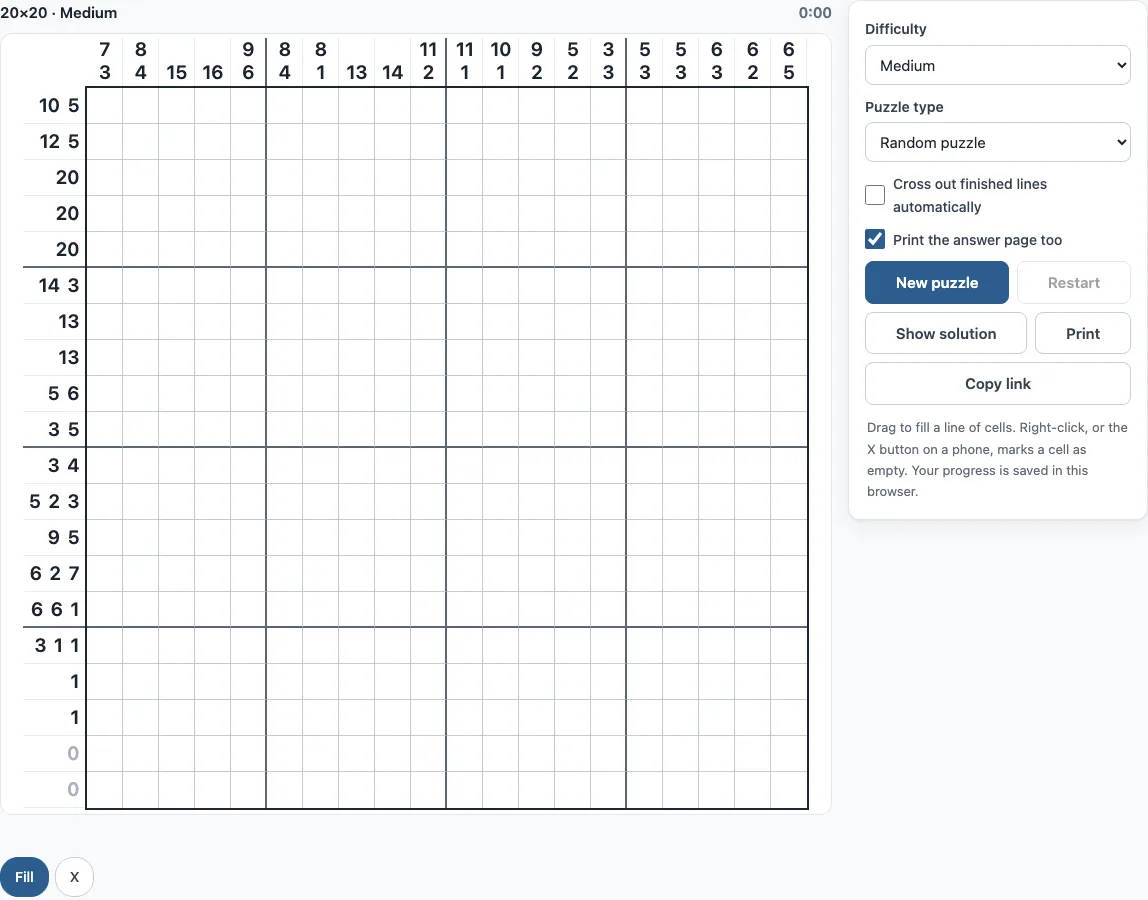
A nonogram 20x20 is a logic puzzle on a grid of 400 squares, and this page lets you play one online for free. You fill squares so that the number clues beside each row and above each column match, and a finished grid can reveal a picture or pattern. This page always plays 20x20 puzzles, so you start a game without picking a size first.
Choose a Difficulty of Easy, Medium or Hard, then a Puzzle type: Random puzzle, or Picture puzzle with a Picture theme. The library holds 11 picture puzzles at 20x20. Every puzzle is made in your browser, and there is no sign-up. Whether you search for a picross 20x20, a nonogram online 20x20 or a set of nonograms 20x20, the rules are the same. Puzzles you print here are free to use at home, in class or in products you sell, such as KDP books.
How to play a 20x20 nonogram
- Open the Difficulty menu and choose Easy, Medium or Hard.
- Choose a Puzzle type: Random puzzle, or Picture puzzle and then a Picture theme.
- Press New puzzle to generate a board.
- Read the clues. The numbers to the left of each row and the numbers above each column give the blocks of filled squares, in order.
- Click a square to fill it, or drag across a row or column to fill several squares at once. The drag stays on the line where it started.
- Right-click a square to mark it with an X when you know it is empty.
- If you are stuck, press Hint to reveal one square that a clue already proves. Press Check to see wrong squares in red, or how many squares are still to fill.
- When the puzzle is solved, the page shows your time, the number of hints used and, for picture puzzles, the name of the picture.
Keyboard shortcuts: arrow keys move, Space or Enter fills, X marks a cross, Backspace clears, Ctrl+Z (Cmd+Z on Mac) undoes and Shift+Ctrl+Z redoes. Restart clears the board and keeps the same puzzle. Copy link gives you a link that opens exactly the same puzzle. To print, press Print and tick “Print the answer page too” if you want the solution on a second page.
How to solve a nonogram 20x20
Solve a 20x20 nonogram one row or column at a time, starting with the lines whose clues force squares. Look for blocks long enough to overlap, then use the spare room in multi-block clues to find the rest. Each new square you place can unlock more lines, so keep going back and forth between rows and columns.
For a single block in a 20-square line, the squares in the middle are always filled once the block is 11 or longer. A block of 11 fills 2 squares and a block of 15 fills 10. For a clue with several blocks, add the blocks and one empty gap between each pair. Subtract that total from 20 to get the slack. If the slack is smaller than a block, that block has filled squares too.
What do the numbers in a nonogram mean?
Each number is the length of one block of filled squares, and the numbers are read in order from left to right or top to bottom. There is at least one empty square between two blocks in the same line. A clue of 0 means the whole line is empty. For example, the clue 3 1 means a run of three filled squares, then at least one empty square, then one filled square.
What is the overlap rule in a nonogram?
The overlap rule says that some squares are filled no matter where a block sits. A clue of 7 in a 10-square row fills squares 4 to 7, because every possible position of that block covers them. In general, if a single block of length n sits in a line of length L and 2n is greater than L, the middle 2n − L squares are filled.
How hard are Easy, Medium and Hard nonograms?
Easy puzzles can be solved one line at a time in at most 4 passes over the board at 20x20, and at least half of all lines give a square on the empty grid, so there are obvious places to start. Medium puzzles can also be solved line by line, but they need more passes. Hard puzzles have one solution, but line-by-line logic gets stuck, so at some point you must test a square both ways and see which choice leads to a contradiction.
Frequently asked questions
Is the 20x20 nonogram free, and do I need an account?
Yes, it is free, and you do not need to sign up. The puzzles are made on your device, and nothing is uploaded.
Is my progress saved?
Progress is saved automatically in your browser and restored when you come back to the page. A 20x20 puzzle takes much longer than a 10x10, so you can close the page and return later.
Can I play a nonogram 20x20 on a phone?
Yes. Use Zoom in and the Move button to work on one part of the board, and press Fit to show the whole grid again. On a phone, tap the Fill or X button to choose what a tap does.
Can I print the 20x20 nonogram?
Yes. Press Print to print the puzzle. Tick “Print the answer page too” if you want the solution on a second page.
Can I undo a mistake?
Yes. Undo (Ctrl+Z, or Cmd+Z on Mac) steps back one move, and a whole drag counts as one move. Redo (Shift+Ctrl+Z) puts it back.
What do the grey clue numbers mean?
A clue turns grey when its row or column matches it exactly. It is a quick way to see which lines are finished, but it does not prove the rest of the board is right: use Check for that.
Can I put 20x20 nonograms from here in a book I sell?
Yes. 20x20 nonogram puzzles from this page are royalty-free for personal, classroom and commercial use, including KDP books, Etsy printables, Teachers Pay Teachers and print-on-demand. No credit is required. The only thing you may not do is copy the generator or the site itself to run a competing service; see the terms.
Related tools
- Nonogram (play online) for the main puzzle page with the same rules and controls.
- Picross online if you know these puzzles by the name picross.
- Easy nonograms when you want to warm up on puzzles that can be solved line by line.
- Hard nonograms when you are ready for puzzles that need testing a square both ways.
- Daily nonogram: three new puzzles every day (10x10, 15x15 and 20x20), the same for everyone, with a 30-day archive.
- Color nonogram when you want clues that use more than one color.
- 10x10 nonograms for a smaller grid that is quicker to finish.
- 15x15 nonograms for a step between 10x10 and 20x20.
- Giant nonograms for boards larger than 20x20.
- Nonogram solver when you want to check your clues or compare your answer.