Binary Puzzle
Fill every cell with 0 or 1: no three equal digits in a line, as many 0s as 1s in each row and column, no two lines alike.
Recent
Your last 10 settings, saved only in this browser. Nothing is uploaded.
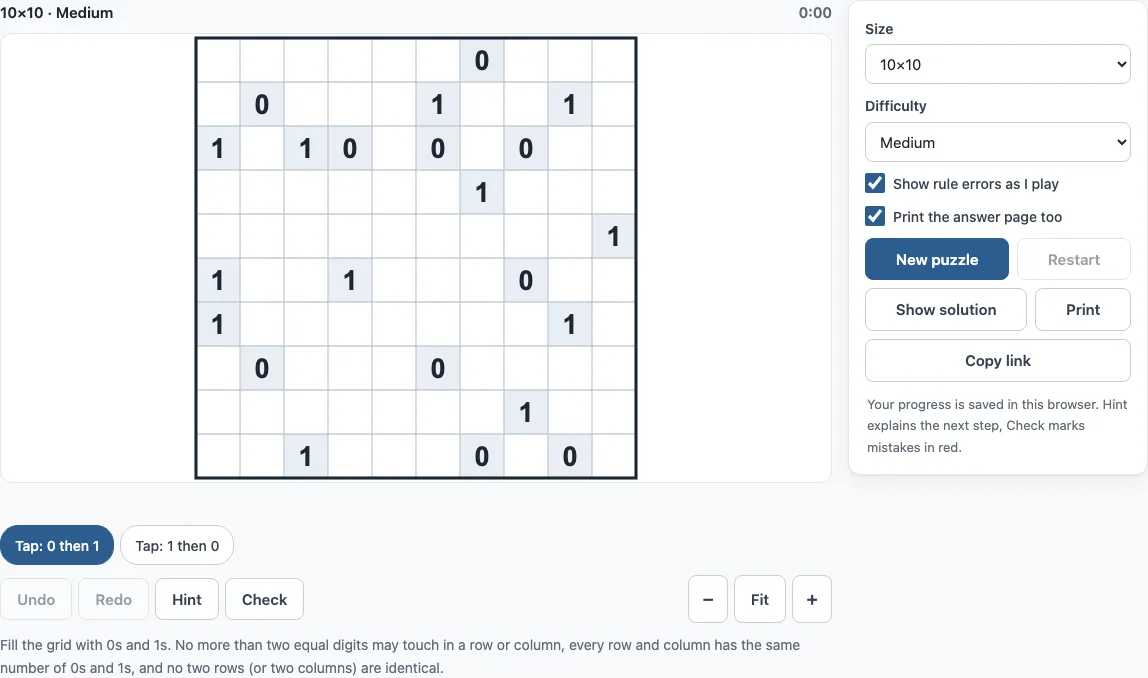
How to play the binary puzzle online
- Choose a size with the Size control: 6×6, 8×8, 10×10, 12×12 or 14×14. The default is 10×10.
- Choose a difficulty: Easy, Medium or Hard.
- Click New puzzle. The puzzle is ready as soon as the page opens. “Generating…” shows while a new one is made.
- Click or tap an empty cell to cycle it through empty, 0 and 1. Bold digits are givens and cannot be changed.
- Press Hint when you are stuck. It highlights the cells involved and explains in one sentence which rule proves the next step.
- Press Check. Cells that break a rule or differ from the solution turn red. If none do, the page says “No mistakes so far” and shows the percentage done.
- When the puzzle is solved, the page shows “Solved in m:ss” and how many hints you used. Choose Next puzzle to keep going.
Right-click cycles a cell the other way. The arrow keys move, the 0 and 1 keys set a digit, Space cycles, and Backspace clears. Undo and Redo work with Ctrl+Z and Shift+Ctrl+Z (Cmd on a Mac). Restart clears the board but keeps the same puzzle. Print gives you the puzzle on its own page, and Copy link saves a link to the exact puzzle so you can share it or solve it on another device.
What is a binary puzzle?
A binary puzzle is a square grid in which you fill every cell with 0 or 1. Some digits are given at the start, and the rest follow from three rules. The grid has an even number of cells per side, and this tool offers 6×6, 8×8, 10×10, 12×12 and 14×14.
The rules are:
- No more than two equal digits may touch in a row or column, so 000 and 111 are not allowed.
- Every row and every column has as many 0s as 1s.
- No two rows are identical, and no two columns are identical.
The tool marks rule breaks in red as you play. Turn off “Show rule errors as I play” if you want a harder game.
How to solve a binary puzzle
Solve a binary puzzle with logic, not guessing. Look for patterns that force a digit, fill those cells, and repeat. The site’s solver names five techniques:
- Pair: two equal digits side by side force the cells on both sides to be the other digit. 00 becomes 1001.
- Sandwich: an empty cell between two equal digits must be the other digit. 0_0 becomes 010.
- Full: a row or column that already has half its cells of one digit gets the other digit in every empty cell.
- Line: look at one row or column on its own. List every way to fill its empty cells without three in a row and with equal counts. A cell that gets the same digit in every way is forced.
- Duplicate: the same as Line, but you also cross out any fill that would copy another complete row or column.
Easy puzzles can be solved with pair, sandwich and full alone, and they keep at least 36% of the cells as givens. Medium puzzles also need line and duplicate. Hard puzzles need you to try a digit and follow it until it leads to a contradiction.
Here is a hint from a 6×6 Easy puzzle: “Row 4, column 3 must be 0. It sits next to two 1s that touch, and a third 1 would make three in a row.” That is the pair rule at work, and the Hint button gives you a sentence like this for each step.
Frequently asked questions
Is this binary puzzle free?
Yes. It is free, needs no account or sign-up, and nothing is uploaded. Your progress and settings are saved automatically in your browser and restored when you come back.
Can I play a binary puzzle on my phone?
Yes. It works on phones, tablets and computers. On a phone, the “Tap: 0 then 1” and “Tap: 1 then 0” chips above the board choose what a tap does, and the “Move” chip lets you scroll a zoomed board.
Can I print binary puzzles?
Yes. Print gives one puzzle per page, with its size, difficulty and rules. Tick “Print the answer page too” to add the solution on a second page, or choose “Save as PDF” in the print dialog. A4 and Letter both work.
Does every puzzle have one solution?
Yes. Each puzzle is generated in your browser and kept only when the site’s solver proves it has exactly one solution. That means it can always be finished by logic, without guessing between two answers.
Which grid sizes can I choose?
You can choose 6×6, 8×8, 10×10, 12×12 or 14×14. The default is 10×10. Smaller grids are quicker to finish, and larger grids take longer.
How do I get the same puzzle on another device?
Press Copy link. It copies a link that holds the size, seed and difficulty, and opening that link gives you exactly the same puzzle.
Are the binary puzzles here OK for KDP or Etsy?
Yes. Binary puzzles from this page are royalty-free for personal, classroom and commercial use, including Amazon KDP puzzle books, Etsy printables, Teachers Pay Teachers and print-on-demand products. No credit is required. The only thing you may not do is copy the generator or the site itself to run a competing service; see the terms.
Related tools
- Star Battle: try it when you enjoy placing stars under row, column and region limits.
- Hitori: try it for another number grid where you shade cells so no number repeats in a row or column.
- Nonogram (play online): try it for a picture puzzle that you solve from row and column number clues.
- Slitherlink: try it when you want to draw a single loop that matches the clues in a grid.
- Masyu: try it for a loop puzzle that follows circle rules on a grid.
- Shikaku: try it to split a grid into rectangles whose areas match the numbers.
- Norinori: try it to shade dominoes, two cells in every region.
- Tents puzzle: try it to place one tent beside every tree with row and column counts.
- Mosaic puzzle: try it when you want digits that count the filled cells around them.
- Aquarium puzzle: choose it for a counting puzzle where water fills tanks level by level.