Heyawake
Shade cells so every numbered room holds that many, shaded cells never touch, and the white cells stay connected.
Recent
Your last 10 settings, saved only in this browser. Nothing is uploaded.
Heyawake is a logic puzzle where you shade cells on a grid divided into rectangular rooms, and this page lets you play it free in your browser. There is no account or sign-up, and nothing is uploaded.
Each room may show a number, and that number tells you how many cells in that room must be shaded. The rules also control where shaded cells can touch and how the unshaded cells connect. Heyawake is a Nikoli puzzle, and the name means roughly “dividing rooms.”
You can choose a board of 6×6, 8×8 or 10×10 cells, at Easy, Medium or Hard difficulty. Every puzzle is generated in your browser from a random seed and kept only when the site’s own solver proves it has exactly one solution, so each one can be finished by logic. Your progress is saved automatically in your browser.
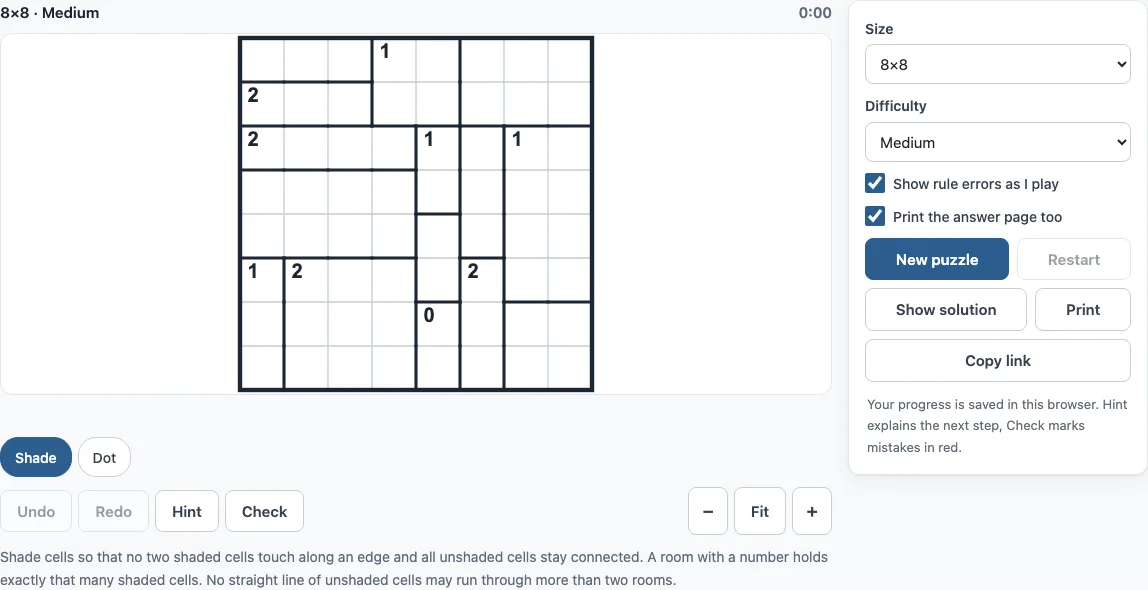
How to use the Heyawake tool
- Pick a Size above the board: 6×6, 8×8 or 10×10. The default is 8×8.
- Pick a Difficulty: Easy, Medium or Hard. Then click New puzzle. If a new puzzle is being made, “Generating…” shows until it is ready.
- Read the room numbers. Each number is printed in the top-left cell of its room.
- Click or tap a cell to shade it. Click or tap it again to clear it.
- Right-click, or use the Dot chip, to mark a cell that must stay unshaded.
- Press Hint when you are stuck. It highlights the cells involved and explains which rule proves the next step. Press Check to see cells that break a rule or differ from the solution, shown in red, or to see your percentage done.
- Leave Show rule errors as I play on to see rule breaks as they happen, or turn it off for a harder game.
- When the puzzle is solved, the page shows “Solved in m:ss.” Choose Next puzzle to continue.
Keyboard players can move with the arrow keys, shade with Space, mark a dot with X and clear with Backspace. Undo and Redo work with Ctrl+Z and Shift+Ctrl+Z (Cmd on a Mac). Restart clears the board and keeps the same puzzle. Copy link saves the size, seed and difficulty in a link that opens exactly the same puzzle on another device.
Puzzles you print here are free to use in class or in products you sell, such as KDP books.
Heyawake rules
The grid is split into rectangular rooms, and some rooms show a number. You shade cells so that no two shaded cells touch along an edge, and all unshaded cells form one connected area. A numbered room holds exactly that many shaded cells, while a room without a number may hold any amount. Finally, no straight horizontal or vertical line of unshaded cells can run through more than two rooms. It may cross one room border, but never two.
How to solve heyawake
Start with the easy openings. A room numbered 0 is fully unshaded. A 2×2 room with 2 has its shaded cells on a diagonal. A 1×3 strip with 2 is shaded at both ends. Long runs of unshaded cells that cross rooms need a shaded cell somewhere along them. On an 8×8 Easy puzzle (seed 3), the first hint is exactly that kind of start: it points at a room numbered 0 and marks its cells unshaded.
After that, use logic in this order:
- Neighbor: cells next to a shaded cell are unshaded.
- Full: a numbered room that already has its number of shaded cells leaves the rest unshaded.
- Fill: if the cells still free to shade are exactly as many as a room still needs, shade them all.
- Run: where a straight line passes through three rooms, the stretch from the last cell of the first room, through the middle room, to the first cell of the third room cannot be all unshaded. So if all but one of those cells are unshaded, the last one is shaded.
Easy puzzles need only these four. Medium adds three more. Room lists every way a numbered room can still hold its number, and a cell shaded in every way must be shaded. Bridge marks a cell unshaded if shading it would split the unshaded cells into two pieces. Sealed shades a cell that can no longer be reached from the other unshaded cells. Hard puzzles also need trial: assume one cell, follow the rules to a contradiction, and the cell is the other way. One assumption at a time is always enough.
What does heyawake mean
Heyawake is a Japanese name written as two words, heya and wake. Together they mean roughly “dividing rooms,” which describes the grid cut into rooms that the whole puzzle is built on.
Frequently asked questions
Is Heyawake free, and do I need an account?
Yes, it is free. There is no account or sign-up. Your progress and settings are saved in your browser, and nothing is uploaded.
Can I play Heyawake on a phone?
Yes. It works on phones, tablets and computers. On a phone or tablet, the Shade, Dot and Move chips above the board choose what a tap does. Move lets you scroll a zoomed board instead of playing.
Can I print a Heyawake puzzle?
Yes. Print shows the puzzle on its own page with its size, difficulty and rules. Tick “Print the answer page too” to add the solution on a second page, and choose “Save as PDF” in the print dialog if you want a file. A4 and Letter both work.
Does every Heyawake puzzle have only one solution?
Yes. Each puzzle is generated in your browser and kept only when the site’s solver proves it has exactly one solution. That means it can always be finished by logic.
Can I share a puzzle or continue it on another device?
Yes. Copy link copies a link with the size, seed and difficulty in it. It opens exactly the same puzzle, so you can send it to a friend or finish it on another device.
Are heyawake puzzles from here free for commercial use?
Yes. Heyawake puzzles from this page are royalty-free for personal, classroom and commercial use, including Amazon KDP puzzle books, Etsy printables, Teachers Pay Teachers and print-on-demand products. No credit is required. The only thing you may not do is copy the generator or the site itself to run a competing service; see the terms.
Related tools
- Hitori: Use it for another shading puzzle where you remove repeated numbers from a grid.
- Kurodoko (Kuromasu): Try it when you want a grid puzzle that uses numbers to count visible cells.
- Nurikabe: Choose it for a puzzle where you shade sea cells around numbered islands.
- Norinori: Play it for a puzzle that pairs shaded dominoes inside marked regions.
- LITS puzzle: Pick it for a region-based puzzle that asks you to shade tetromino shapes.
- Star Battle: Use it for a logic puzzle where you place stars in rows, columns and regions.
- Nonogram: Play it online for a picture puzzle that uses row and column clues.
- All puzzles on the site: Browse every puzzle type when you want to try something new.