Hitori
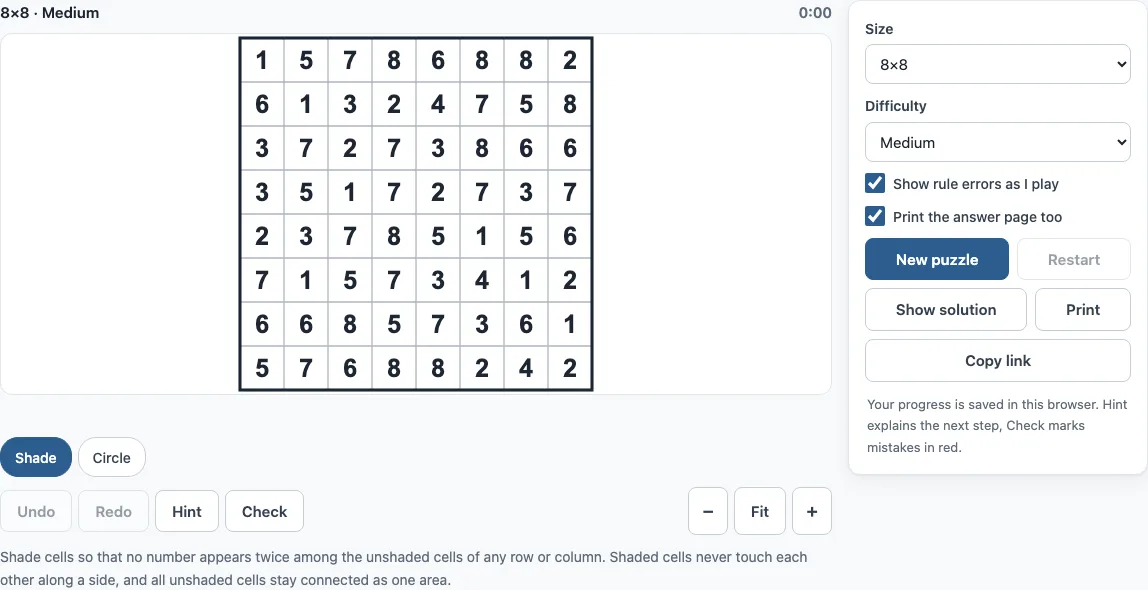
Shade cells so no number repeats in a row or column; shaded cells never touch and the rest stays connected.
Recent
Your last 10 settings, saved only in this browser. Nothing is uploaded.
How to play hitori online
- Choose a Size (default 8×8) and a Difficulty (Easy, Medium or Hard). Select New puzzle to make a different one. A “Generating…” message means a new puzzle is being made.
- Click or tap a cell to shade it. Click or tap it again to clear it.
- Right-click, or press the Circle chip and then tap a cell, to circle a cell you know stays unshaded.
- Use the arrow keys to move between cells, Space to shade, X to circle and Backspace to clear.
- Press Hint when you are stuck. It highlights the cells involved and explains in one sentence which rule proves the next step.
- Press Check to see cells that break a rule or differ from the solution, shown in red. If there are none, it says “No mistakes so far” with the percentage done.
Undo and Redo work with Ctrl+Z and Shift+Ctrl+Z (Cmd on a Mac). Restart clears the board but keeps the same puzzle, and Show solution reveals the answer. Turn off “Show rule errors as I play” if you want a harder game without live warnings.
To print, select Print. The puzzle prints on its own page with its size, difficulty and rules. Tick “Print the answer page too” to add the solution on a second page, or choose “Save as PDF” in the print dialog. A4 and Letter both work. Copy link copies a link that holds the size, seed and difficulty, so it opens the same puzzle on another device.
How to solve hitori
Start with the cells you can prove stay unshaded, circle them, then shade their duplicates. After each shaded cell, circle its four neighbours. The solver uses these named rules, and the hints use the same names:
- Adjacent: every neighbour of a shaded cell stays unshaded.
- Twin: if a cell stays unshaded, the other copies of its number in its row and column must be shaded.
- Sandwich: the cell between two equal numbers, such as the 5 in 3 5 3, stays unshaded, because shading it would leave both 3s to repeat.
- Pair: of two equal numbers side by side, one is shaded and one stays, so every other copy of that number in that line is shaded.
- Escape: an unshaded group with only one way to link up with the rest must go that way.
Easy puzzles need only these five. Medium adds cut: a cell whose shading would split the unshaded area in two stays unshaded. Hard puzzles need trial: assume a cell is shaded, follow the consequences, and if you reach a contradiction, that cell must stay unshaded.
For example, the first hint in the 5×5 Easy puzzle with seed 3 says: “Row 5, column 4 sits between two 5s in the same row. If it were shaded, both 5s would have to stay and repeat. So it stays unshaded: circle it.”
Hitori rules
Every cell holds a number. Shade cells so that no number appears twice among the unshaded cells of any row or column. Shaded cells never touch along a side, although corners may touch. All unshaded cells must stay connected as one area.
Hitori is a Nikoli puzzle. It uses numbers like sudoku does, but you remove numbers from view by shading them instead of writing numbers in. A number that already appears only once in its row and its column can still be shaded in principle, but in a finished puzzle every shaded cell hides a repeat.
Frequently asked questions
Is hitori like sudoku?
Both use numbers in a grid where repeats matter. In hitori, though, the rule applies only to rows and columns, there are no boxes, and you shade cells rather than fill in digits.
What does hitori mean?
Hitori is a Japanese word meaning “alone”, as in “leave me alone”. The name fits the goal: after shading, each number that remains is alone in its row and column.
Is it free, and do I need an account?
Yes, it is free. There is no account or sign-up, and nothing is uploaded. Progress and settings are saved in your browser.
Can I play on a phone?
Yes. It works on phones, tablets and computers. On a phone, use the Shade, Circle and Move chips above the board to control what a tap does.
Can I print it?
Yes. Select Print to get the puzzle with its size, difficulty and rules. Tick “Print the answer page too” to add the solution, and choose “Save as PDF” if you want a file. A4 and Letter both work.
Does every puzzle have one solution?
Yes. Each puzzle is generated in your browser and kept only when the site’s solver proves it has exactly one solution. You can always finish it by logic, without guessing between two answers.
Can I use hitori puzzles from this page in a KDP book?
Yes. Hitori puzzles from this page are royalty-free for personal, classroom and commercial use, including KDP puzzle books, Etsy and Teachers Pay Teachers listings, and print-on-demand products. No credit is required. The only thing you may not do is copy the generator or the site itself to run a competing service; see the terms.
Related tools
- Star Battle: place stars in a grid under row, column and region limits.
- Shikaku: split a grid into rectangles that each hold one number.
- Norinori: shade pairs of cells in regions to meet a set of rules.
- Slitherlink: draw one loop that matches the clue numbers.
- Bridges puzzle (Hashi): connect islands with bridges that match each island’s number.
- Binary puzzle (Binairo): fill a grid with two symbols so no three in a row match.
- Nonogram (play online): fill cells to reveal a picture from row and column clues.
- Mosaic puzzle: shade cells so that each clue counts the shaded cells around it.
- Kurodoko: try it for another shading puzzle where black cells never touch and white cells stay connected.