How to Play Nonogram
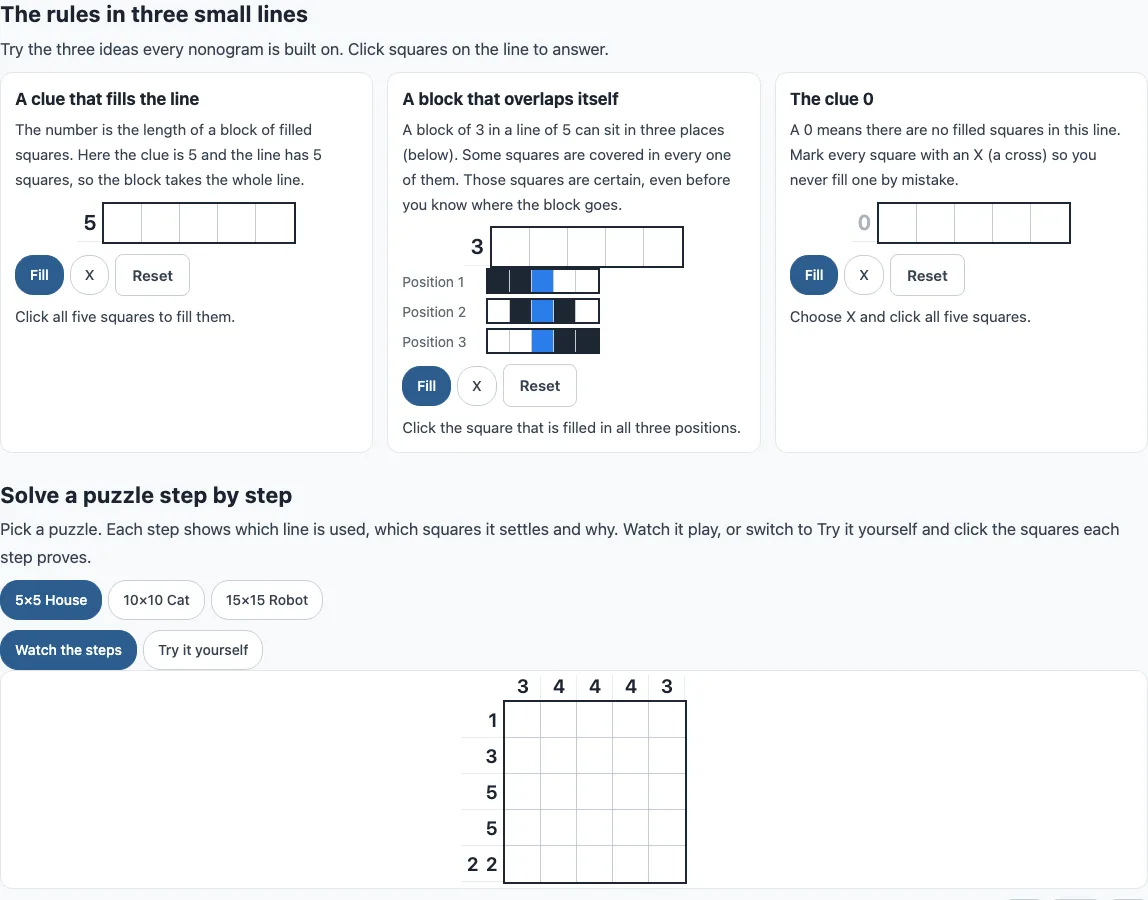
Step through real puzzles: each move is shown on the grid with the reason it is correct.
Recent
Your last 10 settings, saved only in this browser. Nothing is uploaded.
How to play nonogram: fill squares on a grid so that every row and column matches its number clues, which give the lengths of the filled blocks in that line, in order; the finished grid shows a picture. This free page teaches it interactively in your browser, with no sign-up.
Part 1 is a short rules lesson on a single 5-square line. Part 2 is a guided puzzle that you can watch being solved step by step or solve yourself, with every step explained by the technique it uses. The text below covers the rules, the solving method, tips and the named techniques, so you can apply them to any nonogram or picross puzzle.
How to use this tutorial
- Start with Part 1, the rules: clue 5 fills all five squares, clue 3 always covers the middle square, clue 0 crosses out all five. Use Fill, X and Reset to try each one.
- Move to Part 2 and choose a puzzle: 5×5 House (9 steps), 10×10 Cat (25 steps) or 15×15 Robot (33 steps). Start with House if you are new.
- Click Watch the steps and use Next step and Previous. Each step highlights one line, marks the squares it decides and names the technique.
- To let the solution play itself, press Auto play. Press Pause to stop it. Press Restart to go back to the first step.
- Click Try it yourself to solve the puzzle with the tool’s help. The tool shows you only the reason for the step, so you click the squares that the reason proves.
- A wrong click flashes red and shows a hint. If you are stuck, press Show me to outline the target squares. Press Skip this step to fill them in and move on.
- When you finish, read the panel. It lists the techniques used in the chosen puzzle and how often each one appeared.
Press Print this guide to print a one-page sheet called “Nonogram tips for beginners”, which has nine tips and the techniques, followed by the puzzle you chose. Tick Include the answer sheet to add the solution. To keep the printout as a file, choose Save as PDF in the print dialog.
How to play nonogram and picross
To play nonogram or picross, fill in squares so that every row and column matches its clues. The clues are the numbers beside each row and above each column, and they give the lengths of the blocks of filled squares in that line, in order. Nonograms are also called picross, griddlers, hanjie, paint by numbers or picture logic puzzles, but the rules are the same.
How do nonograms work?
Nonograms work by logic, not guessing. Each clue limits where the filled squares can go. Between two blocks in the same line there is at least one empty square, and a clue of 0 means the whole line is empty. Filling the right squares reveals a picture or pattern.
How to solve nonograms (how to do nonograms step by step)
To solve a nonogram, work one line at a time and use only the clues and the squares you already know.
- Find the line with the most information, such as a clue that fills most of the line.
- Work out the slack: the line length minus the sum of the blocks and the gaps between them. For clue 4 4 in 10 squares, the slack is 10 − (4 + 1 + 4) = 1.
- Fill any square that every placement covers. With slack 1, the two blocks of 4 cover squares 2–4 and 7–9.
- Cross out squares that cannot be filled, then move to the next line and repeat.
How do you play picross?
You play picross the same way as any nonogram: read the clues, then fill and cross out squares until every line matches its clue. Start with a line that has a 0 clue or a clue that fits the line exactly, because those give you certain squares straight away. Each square you fill or cross out may unlock a new line.
Nonogram tips and strategy
- Start with the lines where the blocks nearly fill the line: the smaller the slack, the more squares you get.
- Do the clue 0 lines and the exact-fit lines first; they are complete in one move.
- Mark each square you know is empty with a cross as soon as you find it. Crosses show where a block cannot reach.
- When a block is complete, cross the squares on both sides of it.
- Work from the edges: a filled square at the edge, or next to a cross, starts the first (or ends the last) block.
- Switch between rows and columns. Every square you settle gives new information to the line that crosses it.
- Do not guess. When stuck, take the line with the fewest unknown squares and check where each block can still fit.
Nonogram tutorial: the solving techniques
The tutorial names these techniques. Each one is a single logical step.
- Clue 0: the whole line is empty, so cross out every square.
- Exact fit: the blocks plus one gap between each pair fill the line exactly, so there is only one placement.
- Completed line: once all blocks are placed, cross out the rest.
- Edge or glue: a filled square at the edge, or next to a cross, starts the first block, so fill the whole block and cross the square after it.
- Overlap or simple boxes: a block longer than the slack always covers some squares, so fill the overlap of (block − slack) squares.
- Gap too small: open squares shorter than the smallest block are empty.
- Finished block: a filled run as long as the longest block is complete, so cross both of its sides.
- Block reach: when one block is left and part of it is filled, it covers everything between and cannot stretch further than its length.
Frequently asked questions
How to solve hard nonograms?
When every row and column has been worked and squares remain, test a square. Assume it is filled and follow the consequences through the lines. If a line can no longer match its clue, the square must be empty. Every puzzle on this site has one solution, so this method works without blind guessing.
Is there a PDF of these tips?
Yes, you can make one. Press Print this guide to print the “Nonogram tips for beginners” sheet, which has nine tips and the techniques, then choose Save as PDF in the print dialog.
Is it free?
Yes. The tool is free, needs no sign-up and runs in your browser.
Which puzzle size should I start with?
Start with the 5×5 House puzzle, which has 9 steps. Work through the Part 1 rules lesson first, then move to the larger puzzles when the techniques feel familiar.
How do I know which square to start with?
Look for a line whose clue leaves little slack, a clue of 0, or a long block in a short line. In Watch the steps, the first steps of each puzzle show exactly these lines.
Can I practise on more puzzles after the tutorial?
Yes. Easy nonograms are solvable with the line techniques on this page, and the nonogram solver explains the steps of any puzzle you type in.
Related tools
- Picross online: play the same puzzles under the name picross.
- Easy nonograms: practise the techniques on smaller, simpler grids.
- Hard nonograms: try larger puzzles that need the test-a-square method.
- Daily nonogram: solve a new puzzle each day.
- Color nonogram: use the same logic with several colours.
- 10x10 nonograms: move up from the 5×5 House puzzle to a medium grid.
- 15x15 nonograms: tackle the grid size of the Robot puzzle.
- Giant nonograms: solve the biggest grids once the techniques are second nature.