Kakurasu
Shade cells so every row and column adds up to its target; each shaded cell is worth its column or row number.
Recent
Your last 10 settings, saved only in this browser. Nothing is uploaded.
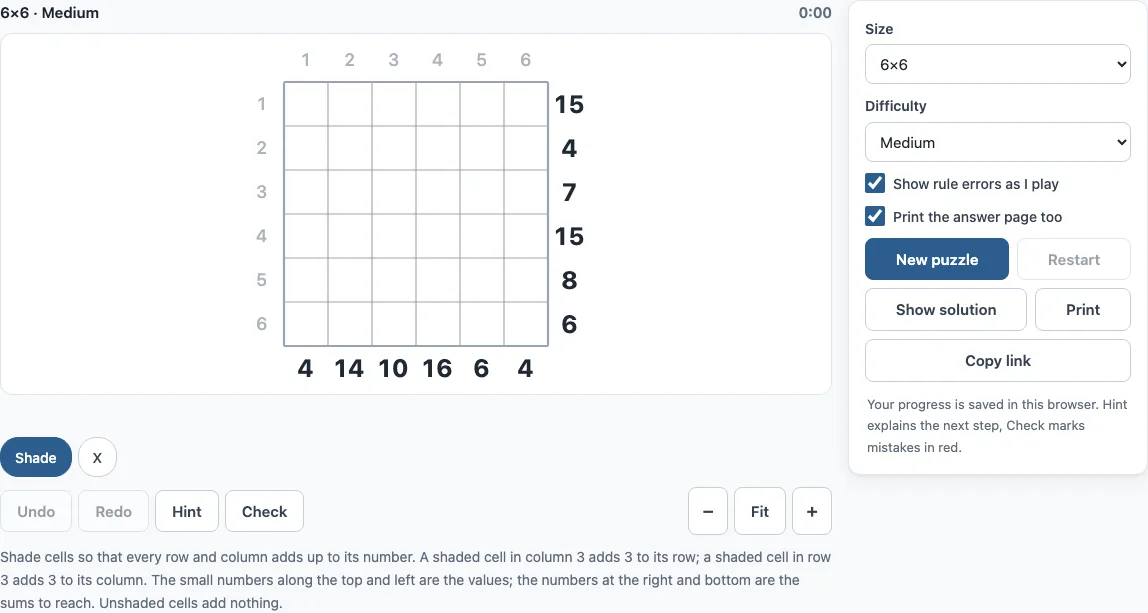
How to use the Kakurasu tool
- Pick a Size (5×5, 6×6, 7×7 or 8×8; the default is 6×6) and a Difficulty (Easy, Medium or Hard).
- Press New puzzle to make another puzzle. “Generating…” shows while it is made. If the puzzle title shows a different level, the closest available level was used.
- Click or tap a cell to shade it. Click or tap it again to clear it.
- Right-click, or tap the X chip, to mark a cell as surely empty.
- Watch the sums at the ends of each row and column. A sum turns grey when you reach it and red when it is broken.
- Press Hint when you are stuck. It highlights the cells involved and explains in one sentence which rule proves the next step. If you have made a wrong mark, it points at that mark first.
- Press Check to see red marks on cells that break a rule or differ from the solution, or a message saying “No mistakes so far” with the percentage done.
- When the puzzle is solved, the page shows “Solved in m:ss” and offers Next puzzle.
Keyboard: arrow keys move, Space shades, X marks and Backspace clears. Undo and Redo work with Ctrl+Z and Shift+Ctrl+Z (Cmd on a Mac). Restart clears the board but keeps the same puzzle.
On a phone or tablet, the Shade and X chips above the board choose what a tap does. The Move chip lets you scroll a zoomed board instead of playing.
Kakurasu rules
Shade cells on an n×n grid so that every row adds up to the number at its right and every column adds up to the number at its bottom. A shaded cell in column j adds j to its row, and a shaded cell in row i adds i to its column; unshaded cells add nothing. Columns are numbered 1 to n across the top and rows 1 to n down the left.
For example, if a row has shaded cells in columns 1, 3 and 4, the row adds up to 1 + 3 + 4 = 8. Puzzles here have about half their cells shaded, and no row or column is empty or full.
How do the row and column values work
Each cell has a fixed value that depends only on its position. For its row, the value is its column number; for its column, the value is its row number. So every cell feeds two sums at once, and you never choose which number a cell is worth.
Kakurasu sums work like a small version of Kakuro: each line is a sum of distinct values. The difference is that the values are fixed by position, so the puzzle is about which positions to shade. When you work on a line, track its “need”, which is its target minus the values already shaded.
How to solve kakurasu
Work one row or column at a time and compare its need with the values of its open cells. The solver uses these rules, which are the same ideas you can apply by hand:
- Zero: if the need is 0, every open cell on the line is empty.
- Full: if the need equals the sum of all open values, every open cell is shaded.
- tooBig: a cell whose value is bigger than the need cannot be shaded, so it stays empty.
- Must: a cell that the other open cells could not reach the need without must be shaded.
- Subset: list every set of open values that adds up to the need. A cell in all of those sets is shaded, and a cell in none of them is empty. For example, with a need of 4 and open values 1, 2 and 3, the only way is 1 + 3, so the 2 stays empty.
- Trial and error: assume a cell is shaded, follow the rules until you reach a contradiction, and then conclude the cell is empty.
Easy puzzles need only zero, full, tooBig and must. Medium adds subset. Hard puzzles need trial and error. In a 6×6 Easy puzzle (seed 3), the first hint reads: “Row 4 still needs 3. The cell in column 4 is worth 4, which is too much, so row 4, column 4 stays empty.”
Frequently asked questions
Is kakurasu free, and do I need an account?
Yes, it is free. There is no account or sign-up, and nothing is uploaded. Your progress and settings are saved automatically in your browser.
Can I play kakurasu on a phone?
Yes, it works on phones, tablets and computers. On a phone or tablet, use the Shade and X chips above the board to choose what a tap does. Fit, the default, sizes the board to the screen width.
Can I print the kakurasu puzzle?
Yes. Press Print to get the puzzle on its own page, with its size, difficulty and rules. Tick “Print the answer page too” to add the solution on a second page, and choose Save as PDF in the print dialog if you want a file. A4 and Letter both work.
Does every kakurasu puzzle have one solution?
Yes. Each puzzle is generated in your browser from a random seed and kept only when the site’s solver proves it has exactly one solution. That means it can always be finished by logic.
How do I check my answer while I play?
Press Check to see red marks on cells that break a rule or differ from the solution. If there are none, it says “No mistakes so far” and shows the percentage done. Keep “Show rule errors as I play” on to see rule breaks as they happen, or turn it off for a harder game.
Can I sell kakurasu puzzles I print from here?
Yes. Kakurasu puzzles from this page are royalty-free for personal, classroom and commercial use, including puzzle books on Amazon KDP, printables on Etsy, Teachers Pay Teachers and Gumroad. No credit is required. The only thing you may not do is copy the generator or the site itself to run a competing service; see the terms.
Related tools
- Binary puzzle: use it when you want to fill a grid with two symbols under counting rules.
- Thermometers puzzle: use it when you want to fill thermometers from their bulbs using clue counts.
- Aquarium puzzle: use it when you want to work out water levels in a grid of chambers.
- Hitori: use it when you want to cross out numbers so that no value repeats in a row or column.
- Star Battle: use it when you want to place stars in regions under row, column and region limits.
- Tents puzzle: use it when you want to place tents next to trees on a grid.
- Nonogram (play online): use it when you want to reveal a picture from row and column clues.
- All puzzles on the site: use it when you want to browse every puzzle type in one place.