Masyu
Draw one closed loop through every circle: go straight through white circles and turn on black ones.
Recent
Your last 10 settings, saved only in this browser. Nothing is uploaded.
Masyu is a logic puzzle played on a grid of white and black circles. Your goal is to draw one closed loop that passes through every circle, following a few simple rules.
This Masyu puzzle runs in your browser. It is free, and there is no account or sign-up. You can choose a board from 6×6 to 12×12 and a difficulty of Easy, Medium or Hard. Each puzzle is generated on the spot from a random seed. The tool shows rule breaks in red as you draw, and it offers hints when you get stuck.
Progress and settings are saved automatically in your browser, so you can come back to an unfinished board. The page works on phones, tablets and computers, so you can play a masyu game on whatever device you have nearby. If you are new to the puzzle, read the rules section below before you start.
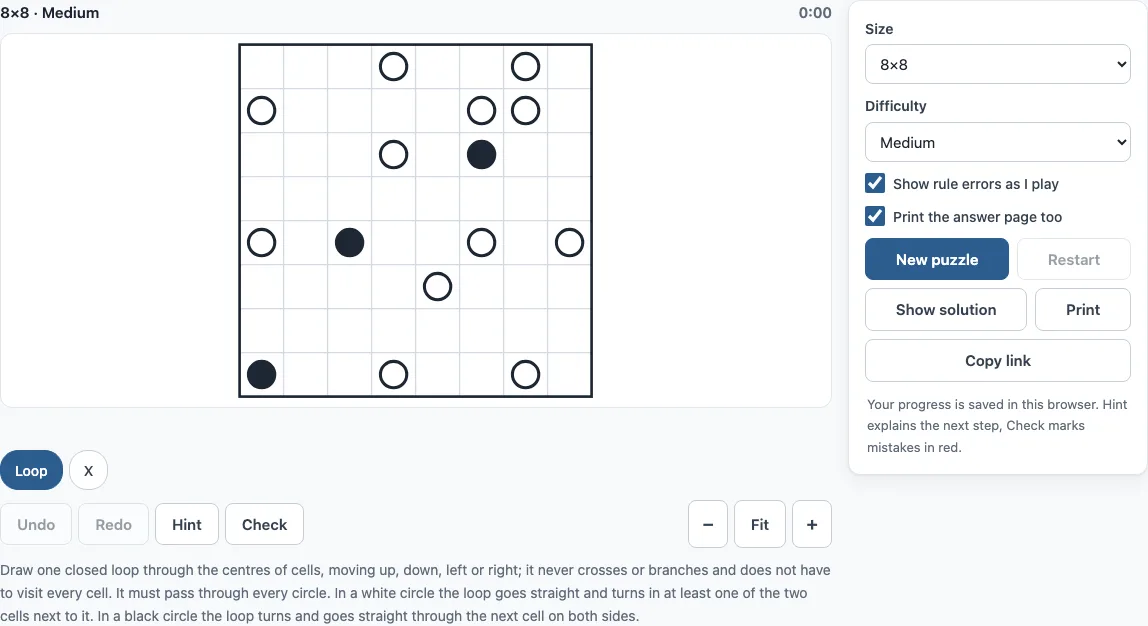
How to play masyu online
- Choose a board size in the Size control: 6×6, 8×8, 10×10 or 12×12. The default is 8×8.
- Choose Easy, Medium or Hard in the Difficulty control.
- Select New puzzle for a fresh board; the first puzzle is ready as soon as the page opens.
- Draw the loop by dragging from a cell centre through neighbouring cells. You can also tap the border between two cells to add or remove one link.
- Mark a link you know is unused by right-clicking it, or by using the X chip on a touch screen.
- Select Hint when you are stuck. It highlights the cells involved and explains in one sentence which rule proves the next step.
- Select Check to see mistakes in red, or to read “No mistakes so far” with the percentage done.
- When the puzzle is solved, the page shows “Solved in m:ss” and how many hints you used. Select Next puzzle to continue.
Keyboard players can move between cells with the arrow keys. Shift plus an arrow key draws or erases the link to the next cell, and Backspace clears the links around the current cell. Undo and Redo work with Ctrl+Z and Shift+Ctrl+Z (Cmd on a Mac). Use Restart to clear the board and keep the same puzzle.
To print, select Print. Tick “Print the answer page too” to add the solution. Copy link copies the size, seed and difficulty, so the same puzzle opens on another device.
Printed puzzles are free to sell in books too.
Masyu rules
Masyu rules are short. Draw one closed loop through the centres of cells, moving up, down, left or right. The loop never crosses itself and never branches. It does not have to visit every cell, but it must pass through every circle on the board.
In a white circle, the loop goes straight through. It also turns in at least one of the two cells next to the circle. In a black circle, the loop turns at the circle. It then goes straight through the next cell on both sides of the turn.
Masyu is a Nikoli puzzle. The name is often explained as “evil influence”, which fits the way a few circles can force a long chain of moves.
How to solve masyu
The best starting point is the black circles, because they are the strongest clues. A black circle near an edge has its arms forced away from that edge. Rows of white circles force straight lines, so they are the next place to look. After that, use the rules of “no dead ends” and “one loop only” to join the pieces.
The solver uses basic rules first. A cell with two links cannot take any more. A cell with one link and one way out must continue that way. An empty cell that is not a circle, and that has only one way out, stays unused because it is a dead end. A circle with only two ways out must use both. A white circle goes straight, so its two opposite links are either both used or both empty.
A black circle has one horizontal arm and one vertical arm. Each arm needs room for two cells in a straight line. If there is no room, the arm cannot point that way. The worked example from the generator, a 6×6 Easy puzzle with seed 3, gives this hint: “Each arm of a black circle needs two cells in a line. There is no room (or the link beyond is empty), so the marked link stays empty.”
Medium puzzles also need intermediate techniques. Next to a white circle, the loop cannot go straight in both neighbouring cells. If one side continues straight, the other side must turn. Two black circles side by side are never joined to each other. A link that would close the loop too early, while other parts are still outside it or a circle is not visited, must be empty.
Easy puzzles can be solved with the basic rules alone. Medium puzzles need the intermediate techniques as well. Hard puzzles need trial and error, so be ready to undo a move if it leads to a contradiction.
Frequently asked questions
Is Masyu free, and do I need an account?
Yes, the tool is free. There is no account or sign-up. Nothing you do is uploaded, because puzzles are generated and saved in your own browser.
Can I play Masyu on a phone?
Yes. The page works on phones, tablets and computers. On a touch screen, use the “Loop” and “X” chips to choose what a tap does, and use “Move” to scroll a zoomed board.
Can I print a Masyu puzzle?
Yes. Select Print to get the puzzle on its own page, with its size, difficulty and rules. Tick “Print the answer page too” to add the solution on a second page. A4 and Letter both work.
Does every Masyu puzzle have one solution?
Yes. Each puzzle is kept only when the site’s own solver proves it has exactly one solution. That means you will never have to choose between two correct answers.
What do I do if my loop has a mistake?
Select Check to see the cells that break a rule or differ from the solution, shown in red. If you are not sure which mark is wrong, select Hint, which points at the wrong mark first.
Can I use masyu puzzles from here in a book I publish?
Yes. Masyu puzzles from this page are royalty-free for personal, classroom and commercial use, including puzzle books on Amazon KDP, printables on Etsy, Teachers Pay Teachers and Gumroad. No credit is required. The only thing you may not do is copy the generator or the site itself to run a competing service; see the terms.
Related tools
- Star Battle: use it for a grid puzzle where you place stars under row, column and region rules.
- Shikaku: use it when you want to split a grid into rectangles that each hold one number.
- Norinori: use it for a shading puzzle where two cells in every region form dominoes that never touch.
- Slitherlink: use it for another loop puzzle, where numbers tell you how many sides of each cell the loop uses.
- Bridges puzzle (Hashi): use it for connecting numbered islands with bridges that never cross.
- Binary puzzle (Binairo): use it for filling a grid with two symbols so that no three match in a row.
- Nonogram (play online): use it for picture puzzles solved from row and column number clues.
- Mosaic puzzle: use it for a grid where numbers show how many neighbouring cells are shaded.
- Galaxies puzzle: play it to split a grid into symmetric regions around dots.