Nonogram Solver
Enter the clues of a puzzle and get its solution, with each logical step and a warning when a puzzle has no or several solutions.
Recent
Your last 10 settings, saved only in this browser. Nothing is uploaded.
A nonogram solver is a free browser tool that takes the row and column clues of a nonogram and works out which squares to fill. Nonograms are also called picross, griddlers, hanjie, paint by numbers or picture logic puzzles, and the rules are the same for all of them. Each number beside a row or above a column gives the lengths of the filled blocks in that line, in order.
This nonogram puzzle solver runs in your browser with no sign-up. Type in your clues, and it shows the solution, a unique answer, or a message if the clues allow more than one solution or none. You can use it as a picross solver, griddlers solver or hanjie solver for grids from 1 by 1 up to 50 by 50 squares.
How to use the Nonogram Solver
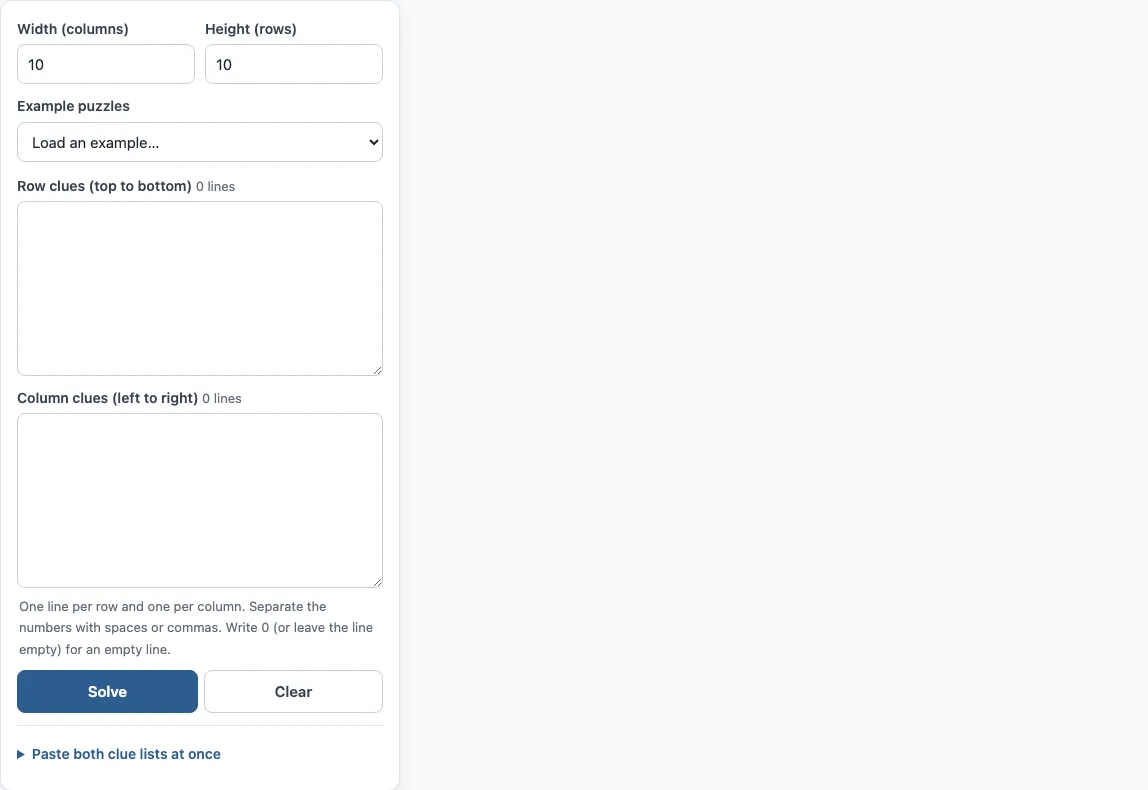
- Set Width (columns) and Height (rows). Each can be from 1 to 50. The size fields follow the number of clue lines you type until you change them yourself.
- In Row clues (top to bottom), type one line per row. Separate the numbers with spaces or commas. For example,
3 1means a block of three, then a block of one. - In Column clues (left to right), type one line per column. A live counter shows how many lines each box has.
- Optional: open Paste both clue lists at once and press Import and solve. To try the tool first, pick a puzzle from the Example puzzles menu.
- If an error list appears, fix the flagged lines and solve again.
- Read the result. It will say ‘unique’ with the time taken, ‘more than one solution’, ’no solution’, or show a partial result after the 4-second limit.
- Click Step through (then Next step) to move through the logic one row or column at a time, or use Play at Slow, Normal or Fast speed. Click Show solution to reveal the full answer. Use Back or Start over to return to an earlier point.
After solving: Copy solution as text (# filled, . empty), Copy link to this puzzle (clues in the address), Play this puzzle (opens the online player) and Print puzzle and solution.
How to solve any nonogram
Every nonogram is solved by reading the clues line by line. The clues for a line give the lengths of its blocks in order, and at least one empty square must separate two blocks. The solver checks every way the blocks of a line can fit around the squares already known. It keeps only the squares that all of those placements agree on. This is called line logic.
The solver repeats this across all rows and columns until nothing else changes. Each step in the step-by-step view names the technique it used. Clue 0 means the whole line is empty. Exact fit means the blocks and gaps fill the line completely. Overlap (simple boxes) marks the squares that every placement of a block must cover. The other techniques, such as Edge (glue) and Finished block, are listed in the same panel.
When line logic stops and squares are still unknown, the solver tests one. It assumes a square is filled. If that leads to a contradiction, the square must be empty. If the puzzle still is not finished, the solver searches. If line logic alone cannot finish a unique puzzle, the squares it left undecided are outlined in purple.
Can a nonogram have more than one solution?
Yes, a nonogram can have more than one solution, because clues alone do not always force one picture. The 2×2 puzzle in the Example puzzles menu has two solutions. When the solver finds two, it shows Solution 1 and Solution 2 buttons, and the squares that differ are outlined in orange.
A puzzle can also have no solution if its clues contradict each other. The 3×3 example in the Example puzzles menu is one of these. The solver stops after it finds two solutions, so for a puzzle with many possible answers, it reports that more than one exists without listing every one.
Frequently asked questions
Can the nonogram solver show me each step?
Yes. Click Next step to move through the solution one row or column at a time. Each step highlights one line, marks the squares it decides, and explains the technique used. Play runs the steps for you at Slow, Normal or Fast speed.
Can a nonogram solver solve a nonogram from a photo?
No. The solver does not read images or photos, so you need to type the clues into the row and column boxes. Count the blocks in each line of your puzzle, write them in order, and enter them.
Is the nonogram solver free, and is anything uploaded?
It is free and needs no sign-up. The solver runs entirely in your browser, and nothing you type is uploaded. The last clues you typed are remembered in your browser, so they are there when you return.
How do I enter an empty row?
Type 0 or - for that line. A blank line also counts as empty. Do not mix a 0 with other numbers on the same line, because the solver lists that as an error. Every row still needs its own line in the Row clues box, even when it is empty.
What happens with a very large or very hard puzzle?
A 50×50 puzzle usually solves in a fraction of a second. Very hard or contradictory clue sets stop at the 4-second limit, and you see the part of the puzzle that line logic could decide.
Can I paste both clue lists at once?
Yes. Open Paste both clue lists at once, then paste the rows and columns separated by a blank line or ---. You can also use labelled rows: and columns: sections, or a one-line form such as 3 1/2/4 | 1 1/5, where a slash separates lines and a bar separates the row clues from the column clues. Press Import and solve to run it.
Related tools
- Nonogram (play online) to solve puzzles yourself before checking your answer with the solver.
- Picross online when you want to play picross puzzles in the browser.
- Easy nonograms for practice puzzles that are a good place to start.
- Hard nonograms when you want puzzles that need more trial and error.
- Daily nonogram for a new puzzle each day.
- Color nonogram for puzzles where squares have more than one colour.
- 10x10 nonograms for small grids that solve quickly.
- 15x15 nonograms for medium-sized puzzles with more lines to read.
- 20x20 nonograms for larger grids that need more steps.
- Giant nonograms for very large puzzles near the solver’s 50-line limit.